ETL Data Migration Guide: Process & Best Practices

Usman AshrafSep 26, 2025
Server To Cloud Migration Diagram

Introduction

Planning to move your company’s data and worried about losing records, breaking reports, or facing long downtime? That’s exactly why you’re here. ETL provides a controllable, auditable, and repeatable framework to safely isolate source records, clean formatting irregularities, and programmatically validate datasets before loading them into a target architecture. This comprehensive guide breaks down the structural phases of an ETL-driven data migration, compares core operational strategies, and provides a production-ready engineering checklist to ensure a zero-error transition.

Core Concepts: Demystifying ETL-Driven Data Movement

At the enterprise scale, executing a successful migration requires moving past simple file-copying operations. Legacy architectures routinely harbor decades of data technical debt, including inconsistent schemas, corrupted fields, and broken formatting. Relying on an ETL-based migration strategy enables engineering teams to construct an isolated processing gate divided into three programmatic vectors:

  • Extract: Connects directly to the underlying source environments (such as legacy relational databases, file systems, or third-party cloud APIs) to safely read the raw delta datasets without adding operational overhead to live production systems.
  • Transform: Applies rigorous business logic filters within a staging layer. This vector deduplicates records, standardizes structural variations, performs character typecasting, and maps incompatible field configurations to align with the destination schema.
  • Load: Programmatically writes the fully reconciled, verified records into the destination repository (such as Snowflake, AWS Redshift, or Google BigQuery), confirming that indices, keys, and operational constraints instantiate flawlessly.

Architectural Comparison: ETL vs. Migration vs. Integration

While data-focused terms are frequently used interchangeably, choosing the correct execution methodology requires a clear understanding of their functional scopes.

Operational Vector

ETL Pipelines

Data Migration

Data Integration

Primary Objective

Extracts, cleans, and restructures datasets for consumption.

Permanently relocates data assets from a source to a new target store.

Unifies fragmented, living systems into a single, synchronized view.

Operational Stance

Continuous or batch processing engine.

One-time architectural transition project.

Permanent, real-time synchronization loop.

Structural Transformation

Heavy (schema modification, enrichment, formatting).

Minimal (focuses on safe, exact-match transport).

Varied (maps shared fields across distinct platforms).

Core Business Use Case

Building analytical data warehouses or lakehouses.

System upgrades, cloud adoption, or infrastructure consolidation.

Breaking down department silos between tools (e.g., ERP to CRM).

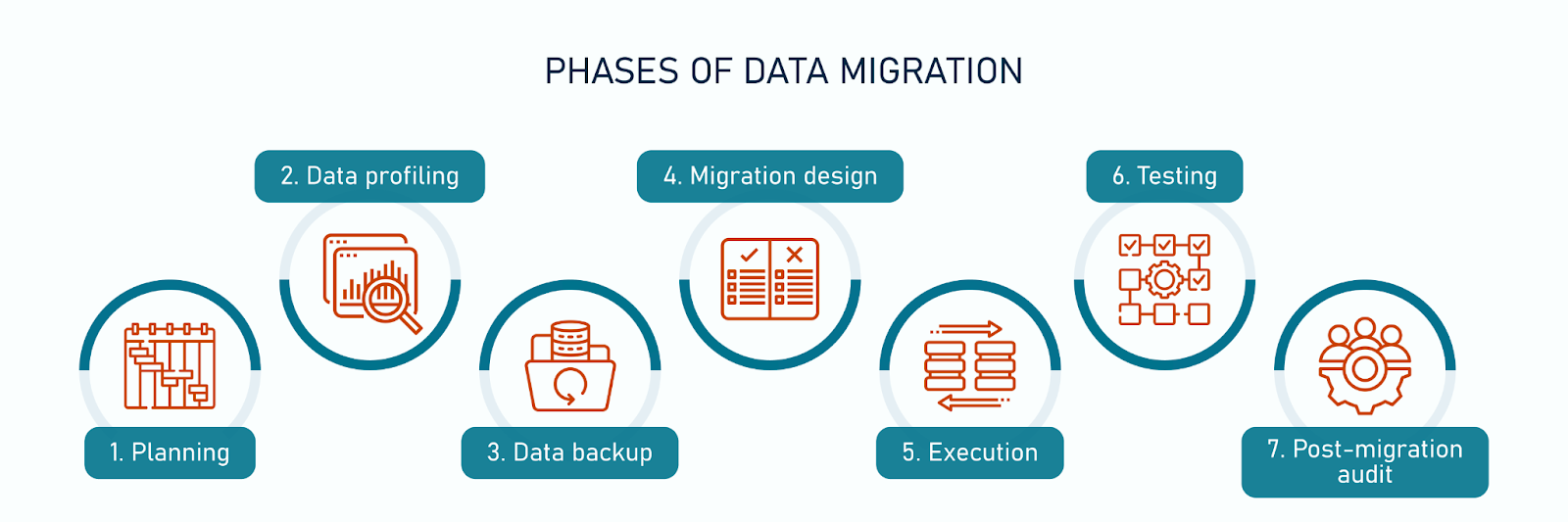
The 7-Stage ETL Data Migration Lifecycle
phases-of-data-migration
https://www.altexsoft.com/blog/data-migration/


Phase 1: Planning

Establish defined boundaries for the migration project, identifying exactly which historical data schemas, tables, and system dependencies fall within the scope. This initial gate outlines strict compliance protocols, assigns stakeholder data ownership roles, and builds strategic contingency rollback paths to protect business continuity if network environments fail.


Phase 2: Data Assessment & Profiling (Bronze Zone Mapping)

Before writing a single transformation line, engineers must profile the raw source data to identify hidden irregularities. Running exploratory queries exposes null-value percentages, invalid strings, and broken records.


Phase 3: Data Backup

Generate immutable, point-in-time cold snapshots of all operational source environments before connecting external ingestion hooks or staging frameworks. This steps acts as an essential fallback layer, ensuring an exact copy of historical data remains completely isolated and secure.


Phase 4: Migration Design

Construct the core transformation architecture of your ETL/ELT pipelines. This is where you create source-to-target field mapping schemas, write explicit character typecasting rules, declare validation parameter thresholds, and configure error-routing logic to automatically isolate malformed rows into dead-letter queues.


Phase 5: Execution

Initialize active bulk data transfers and incremental delta sync loops. Modern enterprise structures deploy automated Change Data Capture (CDC) daemons to stream ongoing source database mutations directly into the target environment in parallel with daily live operations to eliminate system downtime.


Phase 6: Testing

Execute rigorous data quality validation cycles before finalizing the infrastructure cutover. Run targeted unit tests on individual orchestration workflows, perform integration smoke tests across relevant software tools, and conduct extensive User Acceptance Testing (UAT) using parallel runs to ensure financial ledgers match legacy reports exactly.


Phase 7: Post-Migration Audit

Following the loading cycle, teams perform a final end-to-end data validation check. Run automated cross-system row count reconciliations, verify that foreign key relationships and index parameters instantiated flawlessly, and execute cryptographic block-level checksum matches (such as MD5 or SHA-256) to prove perfect bit-level replication before turning off legacy systems.

This comprehensive Data Migration Life Cycle Guide breaks down how to systematically move enterprise datasets across all seven operational lifecycle gates while maintaining strict data quality parameters.

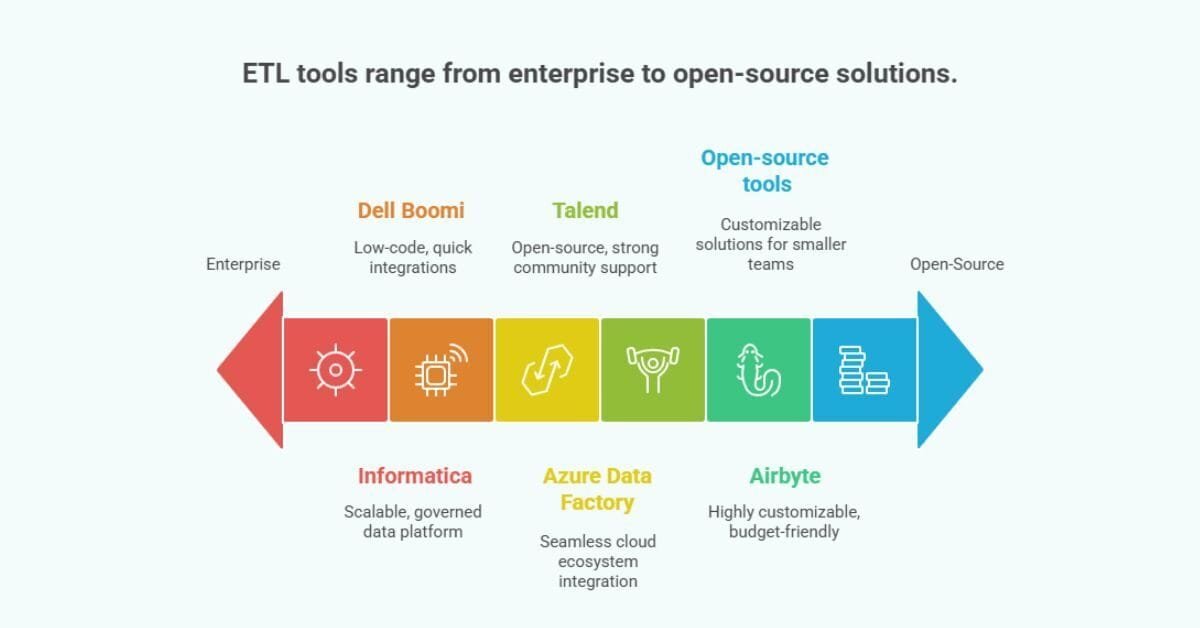
Evaluating the ETL Migration Stack: Tooling Ecosystem

Selecting the right integration framework depends on your existing cloud architecture, internal developer overhead, and compliance parameters:
Etl Tools Comparison Spectrum
  • Informatica PowerCenter: An enterprise-grade data integration platform tailored for massive legacy environments that require strict data governance controls, comprehensive security auditing, and high-throughput transformation engines.
  • Talend Data Integration: An open-source-friendly, highly adaptable tool that provides extensive graphical development interfaces, native cloud connector suites, and strong community-driven plugin architectures.
  • Azure Data Factory & AWS Glue: Cloud-native serverless integration tools optimized for environments already running on public cloud resources. Azure Data Factory Integration Services and AWS Glue provide seamless data lakehouse connectors, automated schema discovery, and effortless scalability.
  • Airbyte: A modern, developer-centric open-source data movement engine that offers highly customizable code-based configurations and an extensive catalog of pre-built source-to-target connectors.
  • Apache NiFi: A powerful, low-latency data flow management engine designed to handle continuous streaming data migration workloads with robust real-time lineage tracking.

The Production-Ready ETL Data Migration Checklist

Deploy this copy-pasteable engineering checklist across your processing environments to enforce data quality and protect your data pipelines from corruption:

  • Data Minimization Cleanup: Run pre-migration profiling scripts to identify and drop redundant, duplicate, or obsolete legacy tables, reducing overall data storage costs.
  • Cryptographic Ingestion Verification: Configure your pipelines to run automated MD5 or SHA-256 block-level checksum validation to confirm bit-level data accuracy after extraction.
  • Dynamic Anomaly Isolation: Set up exception-handling routes to automatically isolate malformed rows in dead-letter queues, allowing pipelines to keep running without crashing.
  • Typecasting Validation Audits: Confirm that all legacy string-based metrics and custom timestamp objects convert accurately into standard UTC datatypes during transformation.
  • Target Referential Integrity Checks: Run automated scripts to verify that primary keys, foreign key constraints, and lookup tables remain linked inside the target platform.
  • Automated Performance Monitoring: Establish real-time tracking thresholds via Slack or PagerDuty to alert on-call data engineers the moment ingestion rates drop or job errors spike.

Conclusion: Securing Pipeline Integrity

Moving business-critical data assets successfully requires shifting away from manual, ad-hoc file transfers toward designing automated, programmatic ETL migration pipelines. By breaking down your strategy into defined data lifecycles, selecting integration tools that fit your technical infrastructure, and filtering out legacy data debt before loading, you protect your systems from data corruption and extended downtime. This disciplined engineering approach ensures your target analytical platforms stay healthy, accurate, and ready to support reliable business decisions from day one.

Key Operational Takeaways

  • Filter Data Early: Do not load raw, unverified data straight into your target systems; always clean and validate records inside isolated staging environments first.
  • Automate Structural Tests: Replace manual row-count sampling with automated, real-time validation checks built directly into your orchestration layers.

Book a Free 30-Minute Meeting

Discover how our services can support your goals — no strings attached. Schedule your free 30-minute consultation today and let's explore the possibilities.

Book a Free Call

Frequently Asked Questions

Standard data migration focuses on moving records from one system or environment to another, often without altering the underlying data models. An ETL-driven data migration extracts raw assets, transforms their structure and schemas to fix quality issues, and loads clean data into the target platform.

Data profiling exposes underlying inconsistencies, missing primary identifiers, and formatting issues within legacy databases. Identifying these schema anomalies early allows engineers to build specific cleaning rules into their transformation code, preventing pipeline failures later.

A dead-letter queue is an isolated database table or storage folder where a pipeline automatically routes malformed or corrupted rows. This isolation keeps bad data from crashing the entire ETL process, allowing valid records to load smoothly while engineers troubleshoot anomalies.

Yes. Modern cloud-native services like Azure Data Factory and AWS Glue utilize localized gateway software agents to establish secure network paths to on-premises servers, letting teams orchestrate hybrid cloud migrations smoothly.

Parallel runs involve processing live corporate workloads through both the legacy platform and the new system simultaneously. Comparing the final outputs across both environments allows engineering teams to verify data processing rules and catch calculation errors before decommissioning the old hardware.

Book Consultation