What is Data Migration? Strategy, Best Practices & Tools

Usman AshrafSep 24, 2025
Database Transfer Process

Introduction

When businesses upgrade their software or move to the cloud, one of the biggest hurdles they face is transferring existing data safely. If not handled properly, data migration can lead to loss, corruption, or system errors that disrupt operations. This makes many companies view the process as complex and risky. The good news is that with the right planning, tools, and strategy, data migration can be smooth and secure. This comprehensive guide breaks down the core patterns of infrastructure modernization, maps out risk mitigation frameworks, and provides a production-ready execution checklist to guarantee a secure, zero-downtime transition.

Core Definition: Defining Enterprise Data Movement

Data migration is the systematic process of transferring datasets, schema definitions, and access configurations from an existing source storage system or database engine to a new target environment. Far beyond executing a bulk copy script, true production-grade migration involves comprehensive structural mapping, schema reconciliation, and typecasting to ensure the underlying data remains fully operational inside the target environment.

When designed correctly, this process acts as an architectural upgrade gate. It cleans up legacy data technical debt, eliminates obsolete records, enforces updated column constraints, and reorganizes physical file layouts (such as optimizing Apache Parquet or ORC partitions) to maximize future query performance.

Primary Architectural Drivers for Platform Modernization

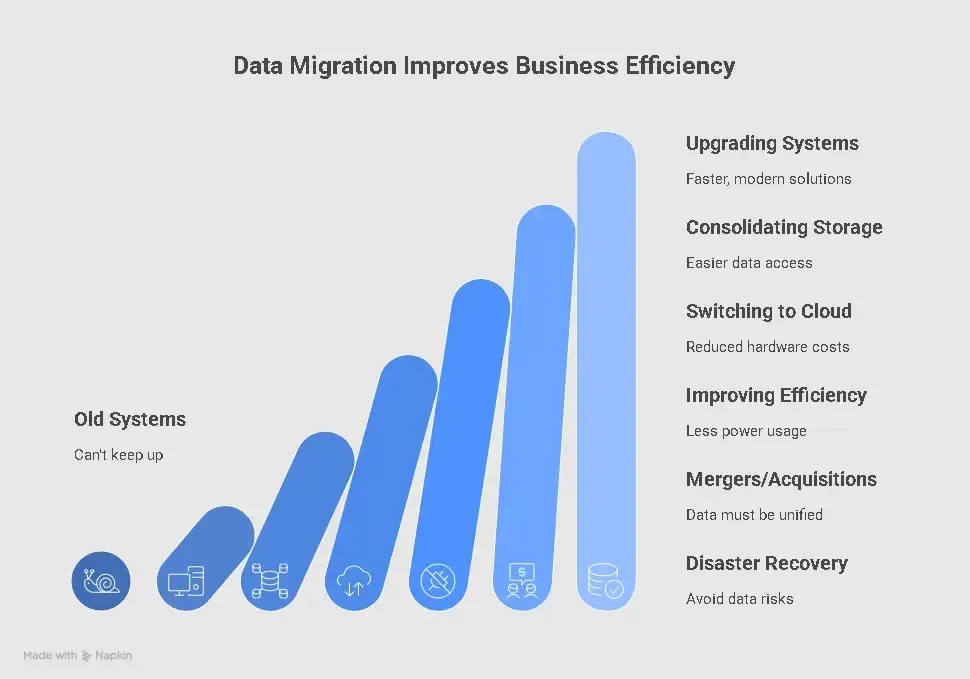
Organizations move away from legacy infrastructures when those environments present operational scale limits or financial liabilities.

  • Legacy Database Modernization: Replacing rigid, on-premises systems with modern cloud data platforms to eliminate restrictive hardware bottlenecks.
  • Storage Consolidation: Merging siloed, disjointed storage arrays into a single, cohesive data lakehouse architecture to remove analytical blind spots.
  • Cloud Infrastructure Transitions: Migrating operational workloads to public cloud providers to transition from high capital expenditure models (CapEx) to flexible operational expenditure frameworks (OpEx).
  • Enterprise Structural Unifications: Combining separate corporate datastores during corporate mergers or acquisitions to build a single, authoritative data environment.
  • Disaster Recovery Optimization: Distributing data assets across geographically isolated regions to meet high-availability service-level agreements (SLAs).

The Five Core Paradigms of Infrastructure Migration

Data migration projects fall into five main categories depending on the target infrastructure layer.

five-data-migration-types
https://www.ispirer.com/blog/data-migration-definition-types-process-best-practices


A. Storage Migration

This lifecycle layer targets the physical hardware layer, focusing on moving raw blocks or file directories between separate storage fabrics (such as moving from standard hard disk drives to high-throughput NVMe arrays). The primary objective is to increase input/output operations per second (IOPS) while decreasing infrastructure latency.

B. Database Migration

This paradigm involves modifying the actual data processing engine. It can be homogeneous (e.g., replicating an on-premises PostgreSQL instance to a cloud-managed PostgreSQL instance) or heterogeneous (e.g., migrating a legacy Oracle database to an analytical cloud warehouse like Snowflake). Heterogeneous migrations require intensive schema conversion steps to reconcile incompatible data types and relational constraints.

C. Application Migration

This path occurs when an organization switches its underlying core software platform (such as replacing a legacy on-premises ERP or CRM system with a modern cloud-native equivalent). Because the source and target applications run on entirely different internal data models, this pattern requires advanced transformations to map legacy object fields into the target application schemas.

D. Cloud Migration

The strategic lifting of data assets, transformation pipelines, and analytical environments out of localized corporate datacenters and deploying them directly into managed public cloud provider infrastructures (such as AWS, Azure, or Google Cloud). This approach maximizes structural elasticity, unlocks on-demand scaling, and exposes data to modern cloud-native AI and machine learning ecosystems.

E. Business Process Migration

This dimension targets the human and operational logic layer of the enterprise. When a company reorganizes its internal workflows, changes business rule management systems (BRMS), or migrates to new automation tools (such as mapping complex task loops within ClickUp, HubSpot, or Jira), the underlying metadata and activity logs must be re-aligned. Business process migration ensures that data lifecycle shifts do not break day-to-day operational handoffs, user access patterns, or automated cross-department workflows during system cuts.

Technical Implementation Execution Mechanics
data-migration-process

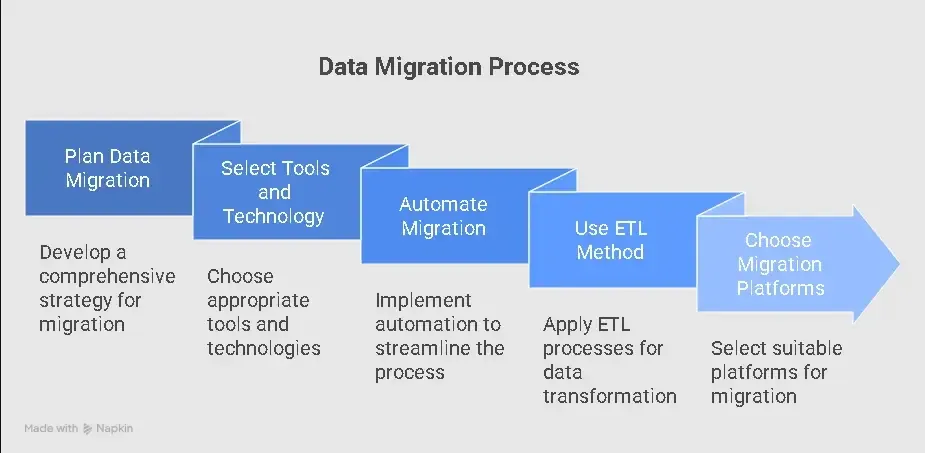
Successful execution depends on choosing the right ingestion style, orchestration platforms, and data integration patterns.

Architectural Cutover Topologies

Teams must carefully choose their migration execution style based on the organization's tolerance for operational downtime:

  • The Big Bang Strategy: The source systems are taken completely offline, the full dataset is migrated to the target, and the new environment is activated. While clean, this strategy introduces a single point of failure and requires a scheduled downtime window that may disrupt global operations.
  • The Trickle (Phased) Strategy: The migration runs continuously in parallel with live operations. Using Change Data Capture (CDC) pipelines, updates are replicated from the source to the target in real time. Once both systems achieve full synchronization, operations are switched over with zero impact on system uptime.

Enterprise Tooling & Processing Frameworks

Modern data replication leverages specialized cloud services to minimize hand-coded pipeline logic. Platforms like AWS Database Migration Service (DMS), Azure Migrate, and Google Cloud Dataflow automate target schema instantiation, manage continuous replication loops, and log validation errors.

For complex transformations, teams utilize a structured Extract, Transform, Load (ETL) or Extract, Load, Transform (ELT) methodology. This setup extracts raw source entities, cleans and structures them within staging areas, and loads optimized tables into the target platform using enterprise integration tools like Talend, Informatica, or Azure Data Factory.

Deep-Dive: Industry-Specific Validation Frameworks

Regulatory mandates and differing data structures alter validation requirements across specific enterprise sectors:

Vertical Sector

Primary Migration Vector

Critical Regulatory Constraint

Core Technical Validation Focus

Healthcare

Electronic Health Records (EHR)

HIPAA / HITECH Compliance

Column-level cryptographic encryption at rest & in transit

Finance

Transactional Ledgers & Audits

PCI-DSS / SOX Mandates

Perfect row-level checksum reconciliation and transactional immutability

Geospatial (GIS)

Spatial Layers & Coordinate Systems

OGC Spatial Standards

Geometric coordinate transformations and spatial index scaling

Public Sector

Legacy Citizen Repositories

Federal Data Privacy Directives

Complete parsing of historical unstructured text and PII masking

Quantifying Structural Risks and Architectural Bottlenecks

Without programmatic validation controls, data migrations frequently encounter critical failure vectors:

  • Silent Data Loss & Integrity Failures: Records drop during high-throughput network transfers due to unhandled packet drops, unmapped column truncation, or structural schema mismatches.
  • Extended Operational Downtime: Poorly configured delta syncs can stall migrations, blowing past scheduled maintenance windows and freezing consumer-facing applications.
  • Referential Integrity Breaking: Incompatible primary/foreign key definitions between the source and target systems can cause cascade failures across related tables, corrupting downstream analytics models.
  • Network Throttling Bottlenecks: Transferring petabyte-scale datastores over standard corporate network switches without dedicated direct connect lines can saturate bandwidth, stalling daily operations.

The Production-Ready Data Migration Checklist
data-migration-buisness-efficiency


Deploy this structured engineering checklist across your migration phases to guarantee architectural alignment and data accuracy:

Phase 1: Pre-Migration Discovery & Profiling

  • Source Profiling Scan: Run comprehensive column-level profiling across all source systems to log null ratios, string lengths, and structural anomalies.
  • Target Target Schema Mapping: Build and validate explicit transformation mapping documents for every heterogeneous data type conversion.
  • Immutable Backup Generation: Generate fully isolated, point-in-time cold backups of all source environments before initializing network connections.
  • Network Capacity Provisioning: Verify that available network bandwidth meets peak migration load requirements without throttling live application traffic.

Phase 2: Active Replicating & Delta Capture

  • CDC Ingestion Check: Confirm that Change Data Capture daemons are actively capturing source database transaction logs without adding system latency.
  • Staged Batch Executions: Run initial bulk data movements in isolated, trackable tranches rather than a single monolithic transfer.
  • Exception Routing Isolation: Configure pipeline error blocks to instantly route failed transformation rows to dead-letter queues without halting the migration flow.

Phase 3: Post-Migration Reconciliation & Verification

  • Row Count Cross-Reconciliation: Match final target table row totals against original source system logs to confirm zero record drops.
  • Cryptographic Checksum Validation: Execute MD5 or SHA-256 block-level checksum validation across migrated files to verify perfect bit-level replication.
  • Referential Integrity Verification: Validate that all foreign key constraints, table relationships, and unique indexes are intact and active on the target.
  • User Acceptance Performance Testing: Run downstream application queries under production concurrent user loads to confirm target read/write performance meets SLAs.

Conclusion: Securing Operational Continuity

Successful data migration requires shifting from simple manual data transfers to designing a programmatic, fully audited replication architecture. By aligning your strategy with defined enterprise paradigms, selecting the right cutover topology, and enforcing structured verification steps, you convert a high-risk system change into a clean architectural upgrade. This disciplined engineering approach eliminates historical data quality issues, protects core business continuity, and positions your data infrastructure to handle modern, high-throughput analytics scales.

Data Prism specializes in delivering secure, seamless, and scalable data migration services tailored to enterprise needs. Whether you’re modernizing legacy systems, consolidating data into the cloud, or upgrading your data warehouse, our team ensures accuracy, compliance, and minimal downtime.

Book a Free 30-Minute Meeting

Discover how our services can support your goals — no strings attached. Schedule your free 30-minute consultation today and let's explore the possibilities.

Book a Free Call

Frequently Asked Questions

Data migration is a focused, one-time project designed to permanently move a dataset from a source environment to a new target home. Data integration is a continuous architectural design pattern that perpetually links separate, living applications to maintain data synchronicity between them in real time.

The primary technical risks include silent data loss from unmapped columns, database schema corruption caused by incompatible system constraints, extended application downtime that violates business SLAs, and broken table dependencies that disrupt downstream reporting models.

A Change Data Capture (CDC) system monitors the transaction logs of your source database in real time. By streaming every new insert, update, and delete directly to the target environment during a migration, CDC allows your team to keep the two systems completely synchronized, enabling a true zero-downtime cutover.

Heterogeneous migrations involve moving data between entirely different database platforms (such as Oracle to Snowflake) that use distinct proprietary datatypes, indexing patterns, and constraint logic. Schema conversion engines translate these variations into compatible structures so that data parses correctly within the target store.

Data engineers prevent corruption by generating immutable backups prior to cutover, using dedicated network channels to avoid packet loss, routing processing errors into dead-letter isolation queues, and running cryptographic block-level checksum audits (such as MD5 matches) between the source and target storage layers.

Book Consultation