Snowflake Transient Tables: Optimize Cloud Storage Costs

Usman AshrafJul 18, 2025
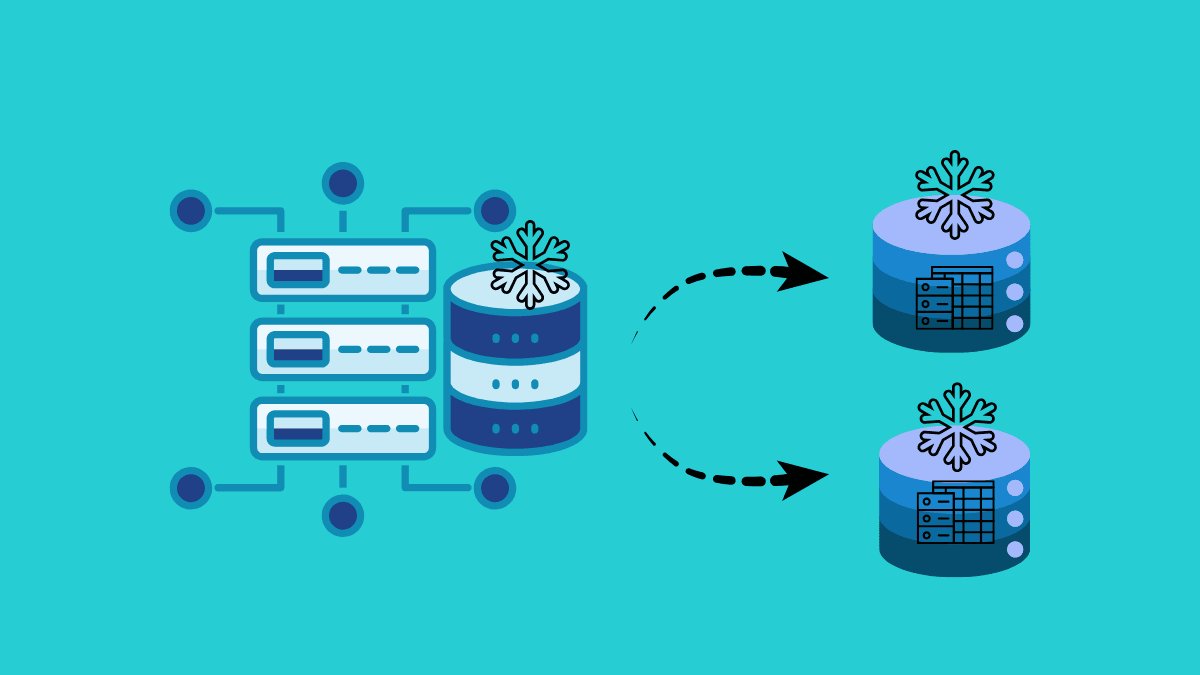
Snowflake Transient Table Flow

Introduction

When engineering data pipelines in Snowflake, defaulting to standard permanent tables for every step of your ETL process is a fast track to inflated cloud storage bills. Permanent tables are designed for long-term disaster recovery, carrying mandatory continuous data protection features like extended Time Travel and a non-configurable 7-day Fail-safe period.

For intermediate datasets, daily staging loads, or short-lived sandbox environments, paying for this level of disaster recovery is an architectural waste. Transient tables solve this problem. By explicitly removing the 7-day Fail-safe period and limiting Time Travel to a maximum of 24 hours, transient tables provide a high-performance, budget-friendly storage architecture for data that can be easily recreated if lost.

Architectural Breakdown: Permanent vs. Transient vs. Temporary

Choosing the correct table type is a foundational data modeling decision. Here is how Snowflake's storage architectures compare at the granular level:

Table Architecture

Time Travel Retention

Fail-Safe Period

Lifespan

Best Engineering Use Case

Permanent (Default)

0 to 90 Days

7 Days (Mandatory)

Until dropped

Source of truth, financial ledgers, Gold analytics tables.

Transient

0 to 1 Day

0 Days

Until dropped

ETL staging, intermediate models, QA sandboxes.

Temporary

0 to 1 Day

0 Days

Current Session Only

One-off computations, session-specific Web Scraping data parsing.

Deploying Transient Tables in the Medallion Architecture
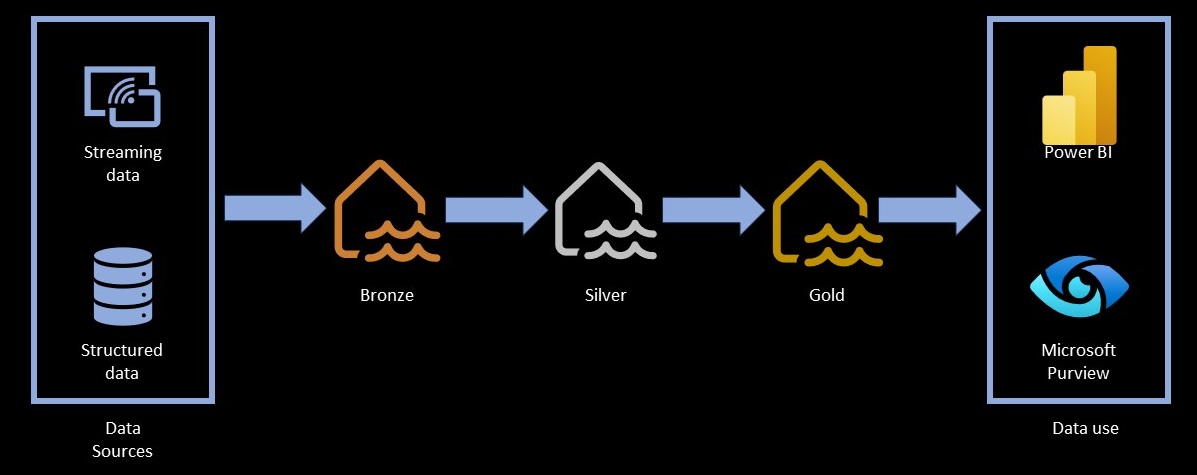
Typical-medallion-architecture-4
https://www.kevinrchant.com/2024/05/03/the-great-number-of-workspaces-for-medallion-architecture-in-microsoft-fabric-debate/

To maximize cost efficiency without risking critical data, data engineers must map transient tables directly to their pipeline processing layers:

  • The Bronze Layer (Raw Data): Use Permanent Tables. This is your landing zone. If an upstream system fails, you need maximum Time Travel and Fail-safe retention to recover raw API payloads or event streams.
  • The Silver Layer (Cleansed & Intermediate): Use Transient Tables. Silver tables undergo heavy daily transformations, truncations, and overwrites. Because Silver data can always be reconstructed by re-running code against the Bronze layer, paying for 7-day Fail-safe storage on these massive daily churns is entirely unnecessary.
  • The Gold Layer (Aggregated Analytics): Use Permanent Tables. These power downstream executive dashboards and require strict disaster recovery protocols.
Note: For teams requiring help structuring these pipeline layers efficiently, explore our Data Pipeline Development and architectural consulting services.

The Financial Impact: Eliminating Fail-Safe Billing

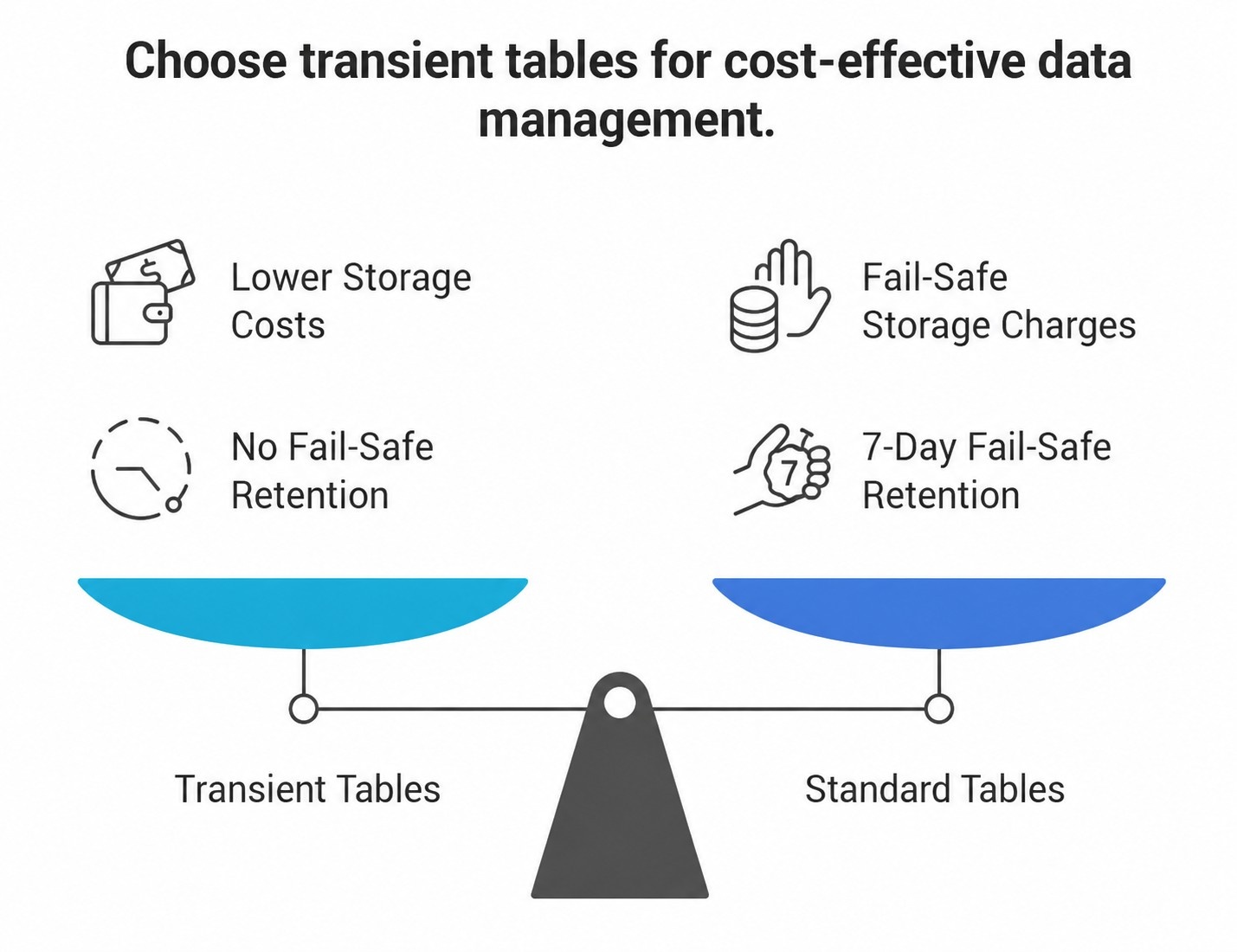
The primary financial driver for adopting transient architecture is the absolute elimination of Fail-safe storage billing.
benefits-jpeg

When you overwrite or drop a permanent table, Snowflake retains the underlying micro-partitions for the duration of your Time Travel window, plus an unalterable 7-day Fail-safe window used by Snowflake support for catastrophic recovery.

If you execute a daily TRUNCATE and INSERT on a 5TB intermediate staging table, you aren't just paying for 5TB of active storage. You are continuously stacking 5TB of hidden historical micro-partitions into a 7-day Fail-safe queue, effectively billing you for 35TB+ of invisible "dead" storage. Switching this staging table to TRANSIENT drops that hidden 7-day accumulation multiplier to zero.

Engineering Implementation & Best Practices

Implementing transient architecture requires a simple Data Definition Language (DDL) adjustment. Use this framework to integrate transient storage safely:

1. Define Transient at Creation

You cannot ALTER an existing permanent table into a transient table. It must be declared explicitly at creation.

SQL
-- Create a new transient table for daily staging
CREATE TRANSIENT TABLE silver_sales_staging (
    order_id VARCHAR,
    revenue NUMBER(10,2),
    processed_at TIMESTAMP_NTZ
);

-- Clone a permanent table as a transient sandbox for testing
CREATE TRANSIENT TABLE qa_sales_sandbox CLONE prod_sales;


2. Combine with Zero-Copy Cloning

Transient tables synergize perfectly with cloning. When developers need a realistic testing environment, cloning a production database as transient ensures that any subsequent modifications do not trigger long-term Fail-safe costs. (Learn more about this mechanism in our Snowflake Zero-Copy Cloning Architecture Guide).


3. Enforce Schema-Level Transience

To prevent developers from accidentally creating expensive permanent tables in development environments, you can define transience at the schema or database level. Any table created within a transient schema automatically inherits the transient property.

SQL
-- All tables created in this schema will automatically be transient
CREATE TRANSIENT SCHEMA dbt_dev_schema;

Conclusion: Smart Storage Allocation

Transient tables offer a highly effective, budget-friendly mechanism to manage non-critical data lifecycles in Snowflake. By stripping away mandatory Fail-safe retention, they allow data teams to execute heavy intermediate transformations and provision massive QA sandboxes without generating compounding storage debt.

When mapped correctly to the Medallion Architecture, reserving permanent storage for raw landings and final aggregates, transient tables ensure your cloud warehouse remains agile, scalable, and relentlessly cost-efficient.

Book a Free 30-Minute Meeting

Discover how our services can support your goals — no strings attached. Schedule your free 30-minute consultation today and let's explore the possibilities.

Book a Free Call

Frequently Asked Questions

No. Snowflake does not support altering a permanent table into a transient table (or vice versa) because the underlying storage metadata mechanisms differ. To convert a table, you must create a new transient table and copy the data over using an INSERT INTO ... SELECT statement.

Yes, they reduce storage costs by skipping fail-safe and extended Time Travel, offering savings for temporary and frequently refreshed data.

Yes, but it is strictly limited. While permanent tables can be configured for up to 90 days of Time Travel (on Enterprise editions), a transient table has a maximum Time Travel retention period of 1 day (24 hours).

No. You are confusing transient tables with temporary tables. Temporary tables are tied to a specific user session and are dropped automatically when that session ends. Transient tables persist globally until they are explicitly dropped via a DROP TABLE command.

No. Transient tables optimize storage costs by eliminating Fail-safe retention. Queries run against a transient table consume the exact same amount of virtual warehouse compute credits as queries run against a permanent table.

Book Consultation