
Table of Contents
In 2025, data integration has evolved from being a back office IT task to a core business strategy. As organizations increasingly rely on data-driven decisions, the ability to seamlessly integrate data from multiple sources, cloud applications, IoT devices, and AI platforms determines not just efficiency but also competitiveness.
Evaluating data integration solutions today is not just about choosing the most popular tool. It is about selecting a platform that aligns with your business goals, supports scalability, and ensures data quality and governance across every stage of your data pipeline
In this complete guide, we will break down the process of evaluating data integration platforms, explore the key factors that define performance and reliability, review leading companies in 2025, and share best practices that help you make the right decision for long-term success.
What Is Data Integration?
A data integration is a platform or system that connects data from multiple sources, transforms it into a usable format, and delivers it to a central destination, often a data warehouse, data lake, or analytics platform. In a simple way, it acts as a bridge that unifies all your fragmented business data into a single, reliable view.
“Data Lake Testing is a process of checking and validating all the data that flows into a data lake to make sure it is accurate, complete and ready to use” Dremio
In today’s digital world, organizations use dozens, sometimes hundreds of data generating tools CRMs, ERPs, marketing platforms, IoT sensors, and more. Without a structured integration system, this data remains siloed, inconsistent, and nearly impossible to analyze effectively.
Types of Data Integration
Different organizations adopt different models depending on their needs and infrastructure:
ETL (Extract, Transform, Load): Traditional approach where data is transformed before being loaded into a storage system.
ELT (Extract, Load, Transform): Modern method used in cloud environments, transforming data after loading it.
API-Based Integration: Enables real-time connectivity between applications using APIs and webhooks.
Data Virtualization: Accesses and combines data from multiple sources without physically moving it.
Streaming Integration: Handles continuous data flow from IoT or real-time analytics systems.
Understanding the Basics: What Are We Evaluating?
Before we look at specific brands or tools, we need to understand what good data integration looks like. At its core, a data integration solution is software that moves data from “Point A” (like your website) to “Point B” (like a database where you analyze trends). But it doesn’t just move it; it often translates the data so it makes sense when it arrives.
When you start your evaluation, you will hear terms like ETL and ELT. These are just fancy ways of describing when the data gets cleaned up.
ETL (Extract, Transform, Load): You clean the data before it lands in your storage. This is the traditional way, ensuring only perfect data enters your system.
ELT (Extract, Load, Transform): You move the data first and clean it later. This is becoming very popular because modern cloud storage is cheap and fast.
To evaluate the data integration platforms company airbyte on etl or evaluate the data integration platforms company informatica on elt, you first need to decide which method suits your speed and storage needs. If you need raw data immediately and have powerful cloud storage, ELT might be your winner. If you have strict compliance rules and legacy servers, traditional ETL might be safer.
Core Criteria: How to Judge a Solution
When you are ready to shop around, you shouldn’t just pick the most famous name. You need to evaluate the data integration solution against specific “must-haves” for your business.
1. Scalability and Reliability
The most common question businesses ask is how to evaluate an integration solution for scalability and reliability. Scalability means the tool can grow with you. If you have 1,000 customers today and 1 million next year, the software shouldn’t crash. Reliability means it works every single time without losing a single piece of information. When testing for this, look for “uptime guarantees” (promises that the system won’t go down) and ask vendors how they handle “data spikes”—sudden bursts of traffic like on Black Friday. A reliable tool will have automated “retry” features, meaning if a connection fails, it tries again automatically rather than just giving up and losing your data.
2. Data Movement and Speed
Speed matters. Some businesses need data instantly (Real-Time), while others are fine waiting until tomorrow morning (Batch). You should evaluate the data integration platforms company airbyte on data movement capabilities if you are looking for flexibility. Tools like Airbyte are famous for being able to move data from almost anywhere to anywhere else very quickly. On the other hand, if you are a massive enterprise with strict rules, you might evaluate the data integration platforms company informatica on data movement, as they are known for handling massive, complex data flows securely, even if the setup takes a bit longer.
3. Ease of Use and Transformation
In 2025, you shouldn’t need to be a coding wizard to move data. This is where “Low Code” comes in. You might want to evaluate the data integration company aws on low code data transformation. Services like AWS Glue have visual interfaces where you can drag and drop boxes to tell the data where to go, rather than writing thousands of lines of code. This is crucial if your team is small or doesn’t have dedicated software engineers.
The Evaluation Process: A Step-by-Step Guide
So, how do you actually do the work of choosing? Do not just read the brochures; follow this process.
Step 1: Define Your "Must-Haves"
Sit down with your team. Do you need data pipeline automation? Do you need strict data management? Write down your non-negotiables. If you need to evaluate the data integration platforms company airbyte on data pipeline automation, specifically test how easy it is to schedule jobs. Can you run them every minute? Every hour?
Step 2: The Proof of Concept (POC)
Never buy software without testing it. Pick two or three top contenders. Maybe you want to evaluate the data integration platforms company talend on airbyte in a head-to-head test. Set up a “race.” Connect both tools to the same data source (like your Google Analytics) and try to send that data to a spreadsheet or database.
Which one was easier to log into?
Which one finished faster?
Did one of them crash?
Is it evaluate the data integration platforms company talend on airbyte ai features that helped? Did one tool automatically suggest the right settings?
Step 3: Check the "Hidden" Costs
Pricing models can be tricky. Some tools charge you a flat fee, while others charge based on how much data you move. If you evaluate the data integration platforms company informatica, you are usually looking at a traditional contract. If you evaluate the data integration platforms company airbyte, specifically the cloud version, you might pay by “credits” based on rows of data. Calculate what this will cost you in one year, not just one month.
Step 4: Look for Future-Proofing (AI and 2025 Trends)
The market is changing. We are seeing more requests to evaluate the data integration platforms company talend on airbyte ai capabilities. This means looking for tools that use AI to fix broken pipelines automatically. If a password changes and the connection breaks, can the tool warn you intelligently? Can it write the code for you? In 2025, a tool without some level of AI assistance will feel outdated very quickly.
Why Evaluation Matters
Choosing a Data Integration Consulting Services is not something to rush. The right evaluation helps you see beyond flashy features and focus on what truly matters. How well the platform fits your business goals, your data setup, and your team’s workflow.
When you take the time to evaluate properly, you avoid headaches later things like slow pipelines, rising costs, or tools that don’t scale as your data grows.
Define Business Goals
Start with clarity. What business problems are you solving through integration reporting inefficiencies, delayed insights, or poor data quality? Outline what success looks like faster analytics, unified dashboards, automated reporting, or better customer visibility.
Mapping your goals and KPIs first ensures that you evaluate platforms not just for their features, but for how well they align with your strategic outcomes.
Assess Current Infrastructure
Before comparing vendors, review your current data architecture.
- What are your main data sources (CRM, ERP, databases, cloud services)?
- Where are your data destinations (data warehouse, data lake, BI tools)?
- Are you operating in a hybrid or multi-cloud environment?
A proper infrastructure assessment helps identify compatibility gaps and ensures that the solution you choose can integrate seamlessly without requiring major reengineering.
Review Pricing Models
A common mistake is evaluating pricing only at face value.Compare total cost of ownership including license fees, compute usage, support costs, and future scalability charges.
Also, assess vendor reliability:
- Do they offer 24/7 customer support?
- How frequently do they update connectors and APIs?
- Is their roadmap aligned with emerging trends like AI integration or multi-cloud workflows?
Conduct a Pilot Test
Before making a final decision, it is necessary to test the platform in your real environment. Running a pilot project helps you assess integration speed, data accuracy, error handling, and performance under live workloads.
Need Help?
Key Factors to Consider
Selecting the right data integration solution goes beyond basic connectivity. It’s about ensuring performance, scalability, and trust. Here are the essential factors every business should evaluate before finalizing a platform.
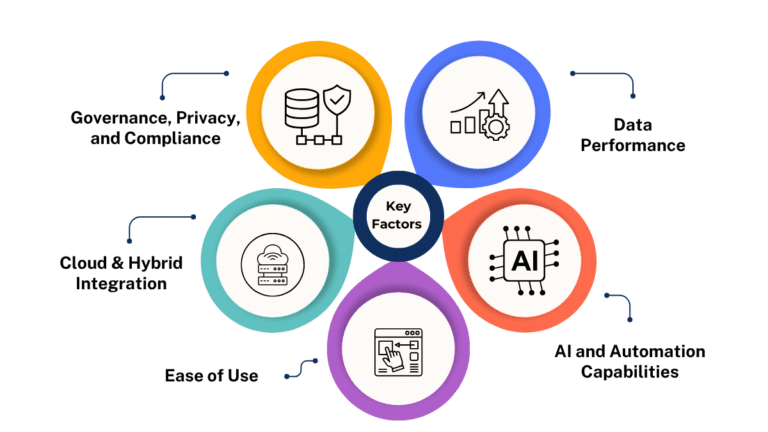
Data Performance
A strong integration solution should deliver fast, reliable, and scalable data movement across all your sources and destinations. Evaluate its ability to handle large data volumes, maintain real-time synchronization, and minimize latency.
“Timely access to high-quality data is the life-giving force of modern decision-making systems and the foundation for accountable knowledge” MDPI Journal of Computers, 2024
AI and Automation Capabilities
In today’s world, AI-driven automation is no longer optional, it is necessary. Advanced platforms use AI to detect anomalies, automate data mapping, and optimize ETL/ELT workflows.
Cloud & Hybrid Integration
Most organizations now operate across multi-cloud and hybrid environments. Choose a solution that offers seamless connectivity between on-premises, private, and public clouds.
Ease of Use
Ease of use directly impacts productivity. Platforms with intuitive interfaces, drag and drop design, and low-code/no-code functionality empower both technical and non-technical users to build and manage data pipelines efficiently.
Governance, Privacy, and Compliance
Data governance is the foundation of trust. Your integration platform should offer robust data lineage tracking, access control, and encryption features to ensure compliance with regulations such as GDPR, HIPAA, and CCPA.
Evaluation of Leading Best Data Integration Companies
Thedataprism
Thedataprism stands out as a next generation integration company focused on intelligent data orchestration. It enables seamless connectivity between cloud, hybrid, and on-premises systems while embedding AI-driven automation for mapping, transformation, and monitoring.
Airbyte
Airbyte has redefined the open-source data integration ecosystem by providing modular, community-driven connectors for virtually any data source.
Informatica Talend
Informatica remains a powerhouse in enterprise data management. Known for its end-to-end data integration, governance, and master data management capabilities, it provides robust scalability across cloud and on-prem environments.
AWS & Azure
The cloud giants AWS and Microsoft Azure continue to dominate the integration space. AWS Glue and Azure Data Factory offer comprehensive, scalable, and secure integration capabilities with tight alignment to their respective ecosystems.
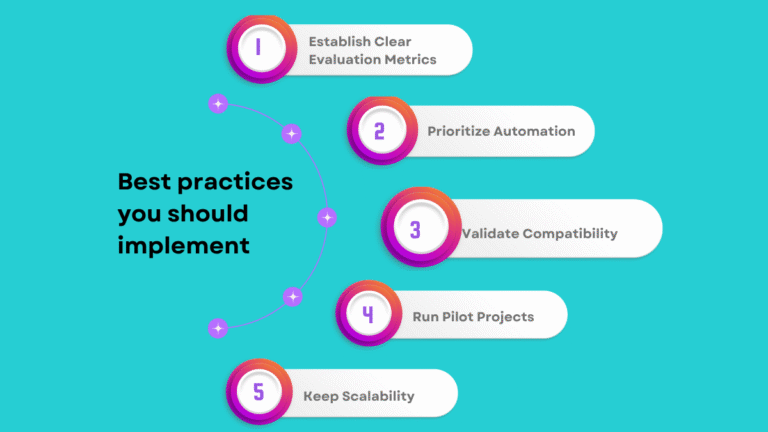
Best practices you should implement
Choosing the right data integration solution is not just about features. It is about how you evaluate and deploy it. These best practices will help you make smarter decisions, avoid costly mistakes, and ensure your integration setup stays strong as your data grows.
Establish Clear Evaluation Metrics
Before comparing tools, define what success looks like for your business.
Decide on measurable goals such as data accuracy, pipeline speed, downtime, and scalability. Having clear metrics helps you evaluate each platform objectively and ensures the final choice aligns with your business outcomes.
Prioritize Automation
Manual integration processes are time consuming and error-prone. Opt for tools that support automation for mapping, transformation, and error detection. Automation not only saves time but also improves consistency and frees up your team to focus on analysis rather than maintenance.
Validate Compatibility
Your integration platform must fit well with your existing tools, databases, and cloud environments. Check connector availability, supported APIs, and data format compatibility.
Run Pilot Projects
Before full deployment, run a pilot test with real data. It helps you assess speed, data accuracy, and system reliability under real-world conditions.
Keep Scalability
Your data needs today would not be the same tomorrow.
Choose a solution that scales easily as data volume, users, and integration points grow.
Prioritize Automation
Manual integration processes are time consuming and error-prone. Opt for tools that support automation for mapping, transformation, and error detection. Automation not only saves time but also improves consistency and frees up your team to focus on analysis rather than maintenance.
Conclusion
To evaluate the data integration solution for your business in 2025 is to balance power with simplicity. If you are a large corporation with strict needs, you might lean towards Informatica for its superior data management. If you are a fast-moving tech company needing to connect 50 different apps quickly, you will likely find Airbyte’s focus on data movement and open-source flexibility more appealing. If you want a balance of robust features and modern speed, Talend remains a strong contender.
Remember, the goal is not to buy the tool with the most buttons. The goal is to buy the tool that makes your “data castle” easy to build, sturdy enough to last, and flexible enough to expand when you are ready to add a new tower. Take your time, test thoroughly, and choose the solution that makes your data work for you, not the other way around.
Frequently Asked Questions (FAQs)
ETL transforms data before loading, ideal for structured, on-prem systems.
It loads data first, then transforms in the cloud — faster and better for real-time analytics
Look for speed, automation, scalability, ease of use, and strong security.
The best platform simplifies data flow while ensuring accuracy and compliance.