Data Migration Testing Strategy: Complete QA Framework

Usman AshrafNov 28, 2025
Server Data Transfer Icon

Introduction

Executing an enterprise infrastructure transition without a comprehensive validation framework introduces major operational vulnerabilities, including silent data corruption, orphaned database records, and broken production systems. A structured data migration testing strategy serves as an essential quality gate. It provides data engineers and QA teams with a systematic method to verify that data moving across environments preserves its original meaning, matches destination schema types, and supports downstream software operations. This guide breaks down the essential lifecycle phases, common architectural bottlenecks, and automated testing strategies required to achieve an accurate, zero-error system cutover.

What is Data Migration Testing?

Data migration testing is the programmatic process of validating that records extracted from a legacy source system are fully transferred, correctly transformed, and safely loaded into a new target environment. Unlike basic software testing, migration quality assurance deals directly with data state changes, schema evolution, and volume validation. It acts as an automated audit layer to guarantee that source datasets match destination tables without loss or structural corruption.


Why a Specialized QA Strategy is Critical

  • Preserving Data Integrity: Moving production systems risks structural distortion. A validation loop guarantees that underlying records, such as historical transactional balances or customer identifiers, remain completely accurate, preserving business value throughout the transfer.
  • Insulating Business Continuity: Extended production downtime during infrastructure modernizations directly damages corporate revenue. Rigorous pre-cutover verification accelerates system cutovers, allowing teams to transition live platforms seamlessly.
  • Enforcing Regulatory Compliance: Organizations handling financial data or personally identifiable information (PII) must comply with strict data protection mandates. Auditable testing frameworks prove that sensitive records are stored securely in the new environment.
  • Minimizing Long-Term Engineering Costs: Resolving structural database anomalies or incorrect schema types after a system goes live requires significant developer resources. Finding and fixing errors early within an isolated staging zone is vastly more cost-effective than attempting post-launch data hotfixes.

Tailoring Tests to Your Migration Topology

Before designing your test phases, you must align your testing strategy with your chosen migration architecture. How you move the data dictates how you test it:

Big Bang (One-Time) Migration

The source system is taken offline, and data is moved in one massive transfer.

Testing Focus

High-stress load testing and strict downtime window validation. You must test if the entire volume can transfer within the 24-48 hour maintenance window.


Trickle (Phased/Intermittent) Migration

Data is moved in chunks by department or module.

Testing Focus

Coexistence testing. You must ensure that the old and new systems can run simultaneously without duplicating records.


Ongoing (Zero-Downtime) Migration

Uses Change Data Capture (CDC) to stream live updates.

Testing Focus

Real-time synchronization lag and delta-sync accuracy.

The 3 Essential Phases of Migration Quality Assurance

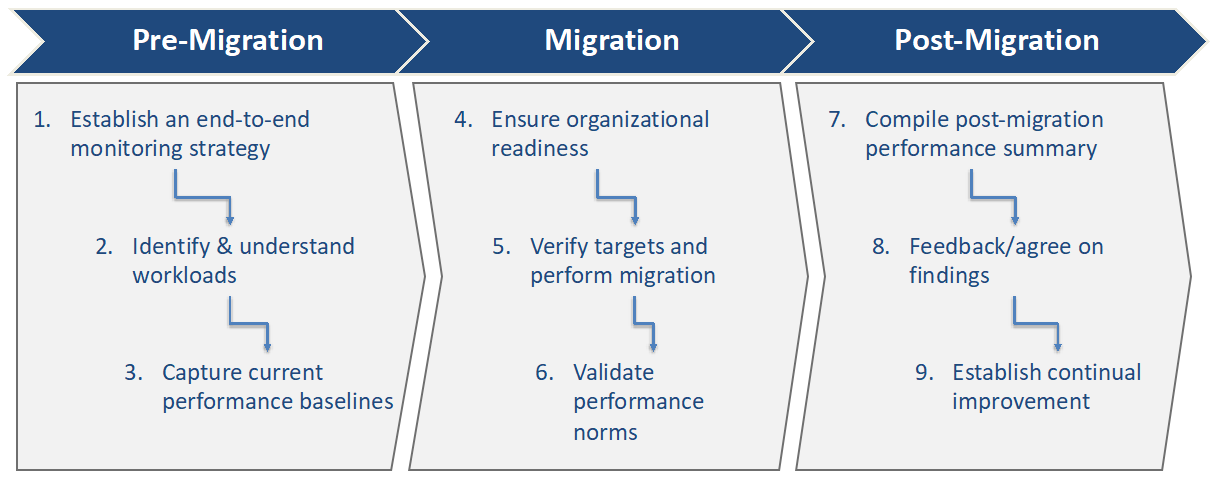
An enterprise-grade migration testing workflow is divided into three distinct validation gates: Pre-Migration, During Migration (In-Flight), and Post-Migration.
cloud-pre-and-post-migration
https://www.eginnovations.com/blog/cloud-migration-best-practices/

Phase 1: Pre-Migration Testing (The Discovery Gate)

Before moving any infrastructure data, QA teams must establish baseline target variables and audit the state of the source datasets.

  • Scope and Volumetric Analysis: Calculate exact source table volumes, row counts, and storage footprints to form a baseline reconciliation log.
  • Source Data Profiling and Cleansing: Scan source tables to flag structural technical debt, including null constraints, invalid data strings, and orphan records. For deep verification of raw landing layers, incorporate the automated validation steps outlined in our Data Lake Testing Checklist.
  • Schema Definition Mapping: Audit source-to-target field mapping rules to ensure incompatible data types (such as legacy VARCHAR variants converting to structured JSON blocks) scale accurately.
  • Immutable Snapshot Isolation: Take complete point-in-time cold backups of all historical storage systems to provide a safe restore point if a catastrophic failure occurs during cutover.


Phase 2: In-Flight Migration Testing (The Execution Gate)

This phase monitors active data transformations and transit pipelines as records stream between infrastructure points.

  • Subset and Sample Ingestion Testing: Execute initial migrations using small, representative testing subsets (e.g., 5% to 10% of records) to verify schema mapping accuracy before running full bulk processing pipelines.
  • Transit Security Auditing: Verify network security parameters to ensure that data in transit is protected using robust encryption protocols, such as TLS 1.3.


Phase 3: Post-Migration Testing (The Reconciliation Gate)

The post-loading gate confirms system usability and provides complete data completeness checks across the new architecture.

  • Full Quantified Reconciliation: Compare destination record totals against baseline source metrics to ensure zero data loss during transit.
  • Target Functional Validation: Run regression testing sweeps across downstream applications to ensure the target software can read, update, and process the migrated records flawlessly.
  • Data Formatting and Mismatch Identification: Verify character encodings, decimal placements, and time zone configurations across target environments to prevent corruption.
  • User Acceptance Testing (UAT): Bring operational business units into the system to run daily tasks, ensuring that the final target layer matches real-world business needs.

To structure your QA process, your engineering team should utilize standardized test cases. Here is a production-ready framework for your testing logs:

Test Case ID

Validation Target

Execution Step

Expected Result

TC-001

Completeness

Run COUNT(*) cross-system queries.

Target row totals exactly match source row totals (Zero data drop).

TC-002

Accuracy

Execute MD5/SHA-256 block-level checksums.

Cryptographic hashes match, proving perfect bit-level transit.

TC-003

Integrity

Query target primary/foreign key relationships.

No orphaned records exist; relational tables are perfectly linked.

TC-004

Transformation

Verify legacy string dates converted to standard timestamps.

All localized strings resolve to standardized cloud timestamp formats.

Critical Technical Challenges to Mitigate

Data teams must design automated mechanisms to handle four common architectural bottlenecks during a data migration project:

Technical Challenge

Root Operational Cause

Mitigating Engineering Action

High Structural Complexity

Nested objects, unstructured arrays, and deep foreign key tables.

Standardize structural transformations early within isolated staging environments.

Pervasive Data Quality Debt

Corrupted inputs, missing values, and duplicate rows.

Deploy mandatory data profiling gates prior to launching ingestion jobs.

Extended System Downtime

Bulk loading limits and slow network pipelines during cutovers.

Implement high-throughput Change Data Capture (CDC) replication daemons.

Failed Rollback Scenarios

Corrupted rollback files or missing historical snapshots.

Conduct complete trial rollbacks within staging layers before go-live.

Enterprise Best Practices for Pipeline Validation

To build a scalable, zero-defect data validation architecture, engineering teams should incorporate these five core design patterns into their deployment plans:

Initialize Testing Frameworks Early

Do not relegate validation scripts to the end of a project. Integrate QA processes directly into the initial pipeline design to catch configuration errors before they reach production layers.


Deploy Automated Validation Tooling

Manual data sampling cannot scale to meet enterprise dataset requirements. Implement specialized, code-based data quality frameworks, such as Great Expectations or dbt data test structures to run automated validation checks across millions of rows in minutes. For an in-depth breakdown of how modern automation architectures distinguish baseline pipeline tracking from advanced data health verification, see our Data Pipeline Monitoring vs. Data Observability Guide.


Form a Cross-Functional QA Team

Build data migration teams that combine technical data platform architects (who oversee pipeline performance) with business analysts (who understand the functional data models). This collaboration ensures that migrations meet both technical constraints and business logic rules.


Rigorously Validate the Recovery Architecture

Never assume your system restore strategy will work perfectly under pressure. Dedicate staging sprints to executing complete, end-to-end rollback simulations to prove your teams can successfully restore legacy operations within designated recovery time objectives (RTO).


Maintain Detailed Testing Logs

Document all migration activities, test results, discovered data anomalies, and hotfixes. Maintaining clear transformation logs simplifies debugging and provides clear compliance audits for internal and external reviews.

Conclusion: Securing Pipeline Integrity

Migrating critical enterprise datasets successfully requires shifting away from manual, ad-hoc file transfers toward designing automated, programmatic ETL migration pipelines. By breaking down your strategy into defined data lifecycles, selecting integration tools that fit your technical infrastructure, and filtering out legacy data debt before loading, you protect your systems from data corruption and extended downtime. This disciplined engineering approach ensures your target analytical platforms stay healthy, accurate, and ready to support reliable business decisions from day one.

Key Operational Takeaways

  • Enforce Multi-Gate Testing: Separate validation rules across three distinct execution boundaries (Pre-Migration, In-Flight, and Post-Migration) to isolate errors early.
  • Automate Data Audits: Replace manual visual checks with automated checksum matches and automated schema validation routines built directly into your orchestration engines.

Book a Free 30-Minute Meeting

Discover how our services can support your goals — no strings attached. Schedule your free 30-minute consultation today and let's explore the possibilities.

Book a Free Call

Frequently Asked Questions

Standard software testing evaluates application features, user interfaces, and code execution paths. In contrast, data migration testing focuses entirely on backend data state changes, schema evolution, and volume validation, ensuring that underlying database records match source systems exactly after transition.

Data engineers verify data completeness by executing automated, cross-system row count reconciliations. Additionally, teams run cryptographic block-level checksum validation checks (such as MD5 or SHA-256) across the extracted source and loaded target layers to guarantee perfect bit-level replication.

While automated engineering checks prove that data moved completely and fits the target data types, UAT involves operational business users verifying the data within real-world workflows. This step ensures that translated schemas match the context needed for daily business tasks and reporting.

A dead-letter queue is an isolated database table or storage folder where an ingestion pipeline automatically routes malformed, corrupted, or schema-incompatible rows. This isolation keeps bad data from crashing the active ETL pipeline, allowing valid records to load smoothly while engineers troubleshoot anomalies.

A CDC daemon continuously reads source database transaction logs and streams changes to the target system in real time. This continuous synchronization allows the target platform to stay up to date in parallel with daily operations, reducing the final cutover window to minutes.

Simulating system rollbacks ensures that if a critical failure occurs during production cutover, the team can quickly restore the legacy environment. Testing the rollback process validates backup files and recovery procedures under pressure, preventing catastrophic data loss or extended business downtime.

Book Consultation