Complete Guide to Evaluate the Data Integration Solutions

Usman AshrafNov 5, 2025
Data Integration Cloud Server Workflow

Introduction

Data integration has evolved from a back-office IT task into a core business strategy. As organizations increasingly rely on data-driven decisions, the ability to seamlessly combine data from multiple sources, cloud applications, IoT devices, and AI platforms determines operational efficiency and market competitiveness.

Evaluating modern data integration solutions is not just about choosing the most popular tool off the shelf. It requires a systematic framework to select platforms that align with your architecture, support enterprise scalability, and guarantee data quality across every pipeline. This guide breaks down how to evaluate various platforms, explore key performance indicators, compare leading vendors, and implement a rigorous testing framework for long-term success.

What Is Data Integration?

A data integration solution acts as an architectural bridge that connects data from multiple disparate sources, transforms it into a unified format, and delivers it to a centralized destination—such as a cloud data warehouse, data lake, or operational data store.

Modern organizations utilize hundreds of isolated tools, including CRMs, ERPs, financial applications, and custom web scraping and extraction architectures. Without a structured integration system, this information remains siloed, structurally inconsistent, and nearly impossible to leverage for accurate analytics.

Types of Data Integration Frameworks

Different integration models address distinct infrastructural requirements and real-time processing needs:

Integration Type

Description

Best Enterprise Use Case

ETL (Extract, Transform, Load)

Data is cleansed and transformed on a dedicated staging server before being loaded into target storage.

Strict compliance environments, legacy on-premises systems, and highly sensitive PII data masking.

ELT (Extract, Load, Transform)

Raw data is loaded directly into a cloud warehouse and transformed post-load using scalable cloud compute.

Cloud-native architectures (Snowflake, BigQuery) prioritizing rapid data ingestion speeds.

API-Based Integration

Enables real-time connectivity between operational applications using REST or GraphQL APIs and webhooks.

SaaS-heavy environments, CRM syncing, and microservices architectures.

Data Virtualization

Accesses and combines data from multiple sources in a logical layer without physically moving the underlying files.

Ad-hoc reporting and scenarios where data replication is legally or logistically restricted.

Streaming Integration

Handles continuous, event-driven data flow in real-time, leveraging high-throughput message brokers.

IoT sensor tracking, live fraud detection, and active financial transaction logging.

Understanding the Basics: ETL vs. ELT

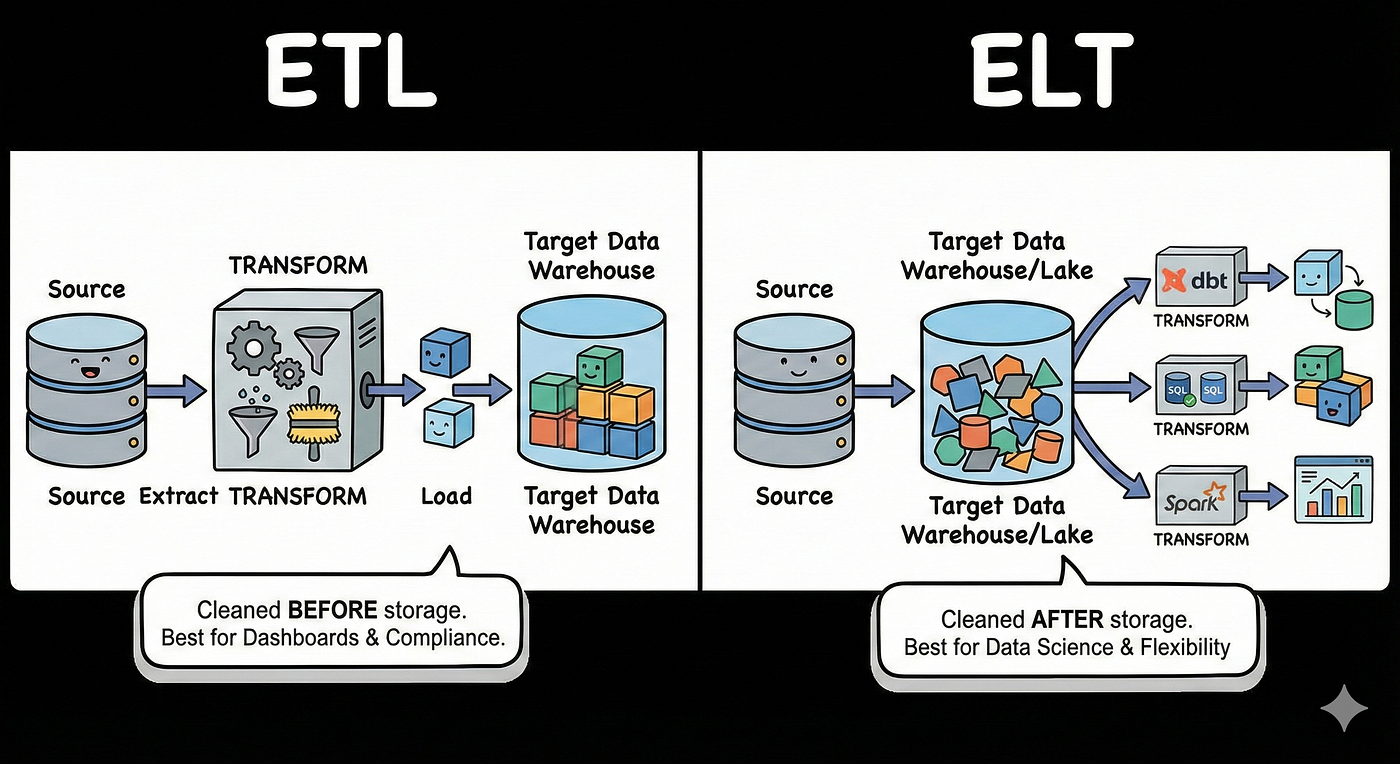
A primary point of comparison when reviewing data integration solutions is identifying when data transformation occurs. This divides your architectural options into two primary categories:
etl-vs-etl-medium
  • ETL (Extract, Transform, Load): Because data is transformed before hitting its final destination, this framework guarantees that only highly sanitized, structured, and compliant records enter your data ecosystem. It is the safest route for legacy infrastructure or strict data governance frameworks.
  • ELT (Extract, Load, Transform): This cloud-native framework prioritizes speed by shifting the transformation step into the target data warehouse. Because modern cloud storage and compute scale independently and cost-effectively, ELT allows data teams to store raw data immediately and apply modeling layers downstream as business logic evolves using modern frameworks like dbt (data build tool).

Core Criteria: How to Judge Integration Solutions

When comparing software vendors, your engineering team must look past marketing features and evaluate solutions against rigid technical metrics:


1. Scalability and Reliability

An integration solution must scale seamlessly alongside data volume growth. If an infrastructure shifts from handling thousands of rows to millions, the pipeline must not throttle or drop packets. Look for automated retry logic and dead-letter queueing; if a connection drops mid-sync due to an external API rate limit, a reliable system will automatically pause, queue the payload, and attempt a retry rather than failing completely.


2. Data Movement and Throughput Speed

Speed requirements dictate your tooling selection. If an organization requires instant data availability, event-driven streaming tools are mandatory. Conversely, if overnight data synchronizations are sufficient, batch-oriented solutions offer a lower operational cost.


3. Low-Code vs. Code-First Transformation

Evaluate solutions based on your engineering team's capabilities. If your data stack relies on dedicated data engineers building customized Python scraping scripts or complex pipeline flows, code-first platforms provide maximum flexibility. If your team consists primarily of business analysts, low-code visual interfaces with drag-and-drop orchestration are critical to reduce deployment time.

The Evaluation Process: A Step-by-Step Guide
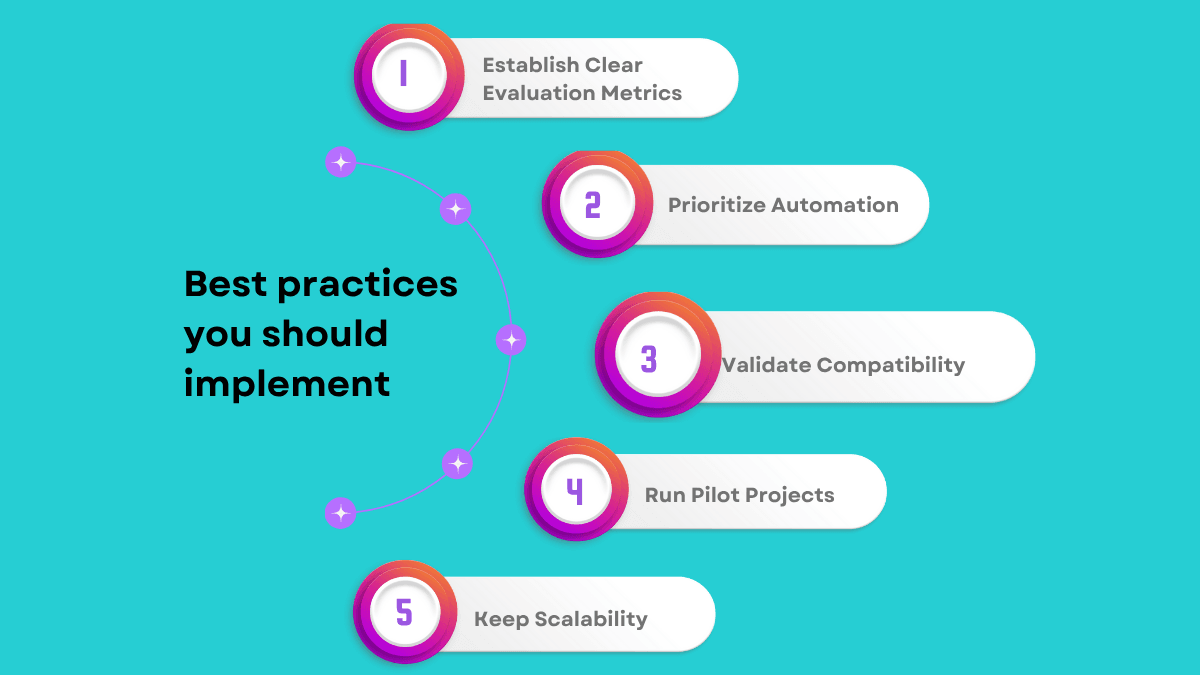
Data Integration Best Practices List

Follow a structured engineering proof-of-concept (POC) rather than buying solutions based purely on vendor documentation:

  • Step 1: Map Your Existing Topology: Document all active data sources (production databases, external APIs, scraped property or real estate endpoints) and target destinations (warehouses, lakes).
  • Step 2: Execute a Staged Race: Deploy two or three competing tools in a test environment. Connect them to identical source sandboxes, execute a synchronized run, and measure deployment complexity, resource consumption, and ingestion speeds.
  • Step 3: Analyze the Total Cost of Ownership (TCO): Review pricing models carefully. Legacy enterprise tools often require flat annual software licenses, while cloud-native integration platforms bill continuously based on rows synced or compute credits consumed. Project these costs out across your anticipated data scaling trajectory.
  • Step 4: Assess Schema Drift Management: Evaluate how each software option handles unexpected structural changes. If a source database changes a column type or an API alters its JSON payload, the integration platform should intelligently alert data teams or handle the drift without breaking the downstream pipeline.

Tailoring Tests to Your Migration Topology

When evaluating solutions for major data migration initiatives, your testing strategy must directly adapt to the underlying architecture of how data is moved. For a deeper breakdown of these deployment blueprints, refer to our Data Migration Strategy & Best Practices Guide:

  • Big Bang (One-Time) Migration: The source system goes offline, and data transfers in a single massive window. Testing Focus: High-stress load testing and strict downtime window validation. Your tooling must prove it can process the entire database volume within your maintenance window.
  • Trickle (Phased) Migration: Data moves incrementally by department, module, or region. Testing Focus: Coexistence testing. The evaluation framework must verify that the legacy and modern systems can run simultaneously without generating duplicate transactional logs.
  • Ongoing (Zero-Downtime) Migration: Leverages Change Data Capture (CDC) to stream live operational updates continuously. Testing Focus: Real-time synchronization lag and delta-sync cryptographic verification.

The Data Migration Test Case Matrix

To properly audit the accuracy of competing data integration solutions during a POC or production deployment, utilize a standardized test case matrix to validate data pipelines:

Test Case ID

Validation Target

Execution Step

Expected Result

TC-001

Completeness

Execute COUNT(*) queries across source and target tables.

Target row totals match source row totals exactly, confirming zero data drop.

TC-002

Accuracy

Run block-level cryptographic checksums (MD5/SHA-256).

Hashes match completely, proving perfect bit-level data transit.

TC-003

Integrity

Audit primary key, foreign key, and relational constraints.

Relational integrity remains unbroken; no orphaned records exist in target.

TC-004

Transformation

Verify source datatypes (e.g., string dates) conform to target formats.

Localized source strings correctly resolve to standard cloud timestamp formats.

Evaluation of Leading Data Integration Platforms

An objective overview of the top tools and platforms dominating the data integration landscape:

  • Data Prism (Custom Orchestration): For unique data collection architectures, commercial off-the-shelf tools often fail due to anti-bot restrictions or complex API limits. Partnering with a specialized Data Engineering Consultancy provides custom-engineered Python architectures and tailored pipeline control.
  • Airbyte Open-Source Engine: A premier open-source data integration platform favored for ELT workflows. Its modular structure allows engineering teams to build, scale, and customize connectors quickly across diverse APIs.
  • Informatica Data Management & Talend: Enterprise-grade powerhouses built for comprehensive data quality, master data management (MDM), and deep compliance auditing across complex, multi-cloud enterprise networks.
  • AWS Glue & Azure Data Factory: Serverless, cloud-native integration suites that scale horizontally automatically. Azure Data Factory Integration Services and AWS Glue Serverless Integration are ideal for organizations deeply embedded inside a single cloud provider's ecosystem, significantly reducing security configuration friction.

Best Practices You Should Implement

Mandate 100% Automated Validation

Historically, QA teams relied on random data sampling (e.g., manually verifying 5% of records) to sign off on a pipeline. In modern data stacks, manual sampling introduces unacceptable risk. Deploy programmatic validation engines to reconcile 100% of your datasets. To understand the difference between basic uptime tracking and advanced programmatic validation, review our Data Pipeline Monitoring vs. Data Observability Guide.


Establish Clear Threshold Governance

Before rolling data into production, define what an acceptable error rate looks like. For non-critical metadata, minor formatting variances might be acceptable. For core financial or personal identity records, data validation rules must enforce a zero-tolerance policy for sync failures.


Build Decoupled Architecture

Ensure your data integration layer remains decoupled from your storage and processing layers. This isolation guarantees that if you choose to swap out your cloud data warehouse in the future, your core API Integration Architectures and ingestion pipelines remain fully intact.

Conclusion

Evaluating data integration solutions requires balancing processing power with operational complexity. If your organization handles highly sensitive, regulated enterprise records, a deeply governed ETL platform is essential. If you are a fast-growing, cloud-native tech team looking to sync scores of SaaS applications simultaneously, open-source ELT flexibility offers superior agility.

Take time to build isolated proofs-of-concept, test with real workloads, and choose the integration setup that keeps your pipelines reliable, secure, and ready to scale.

Book a Free 30-Minute Meeting

Discover how our services can support your goals — no strings attached. Schedule your free 30-minute consultation today and let's explore the possibilities.

Book a Free Call

Frequently Asked Questions

ETL transforms data on an intermediary server before loading it, safeguarding target destinations from unmasked or non-compliant records. ELT extracts data directly into modern cloud warehouses and uses the warehouse's localized compute power to handle transformations downstream, resulting in significantly faster ingestion speeds.

An optimal platform balances performance reliability, automated retry logic during traffic surges, native security compliance certifications (SOC2, GDPR, HIPAA), ease of deployment, and a transparent pricing model that aligns predictably with data volume expansion.

Data validation ensures that as records move across infrastructures, no data corruption, row drops, or structural clipping occurs. Automated validation checks protect business intelligence layers from making strategic assumptions based on broken or incomplete datasets.

Book Consultation